

close
Choose Your Site
Global
Social Media
Views: 0 Author: Site Editor Publish Time: 2025-12-04 Origin: Site


The food industry is under constant pressure to meet the growing demand for speed, especially in the pizza sector. With consumers increasingly favoring convenience and quick service, pizzerias must adapt to these demands. Pizza production lines are a critical solution for pizzerias looking to enhance efficiency, reduce wait times, and ensure consistent quality, all while maintaining the high standards customers expect.
In this article, we’ll explore how pizza production lines enable pizzerias to meet the rising demand for faster service and how they help improve speed, increase production capacity, and meet consumer expectations for quick and consistent service.
In recent years, fast-casual dining and delivery services have surged in popularity. As customers seek faster, more convenient dining options, the need for quick service has never been greater. For pizzerias, this has meant the need to not only serve great pizza but to do so quickly.
Consumers increasingly demand not only quality but speed. Delivery times are becoming a critical part of the overall dining experience. Whether in-store or through delivery services, a fast turnaround time is essential for customer satisfaction, particularly in high-demand periods such as lunch hours or weekends.
The speed at which a pizzeria can produce and deliver a pizza plays a direct role in customer satisfaction. Long wait times can lead to frustration, loss of sales, and negative reviews. To meet these expectations, businesses must focus on streamlining their production processes. Pizza production lines have become a game-changer in ensuring that pizza production is fast, efficient, and consistent.
Core Keyword Focus: Pizza production line
Pizza production lines help pizzerias streamline the entire pizza-making process, from dough preparation to baking, resulting in faster production cycles and reducing wait times. Let’s explore how automation in various stages of the process leads to faster, more efficient service.
One of the most time-consuming aspects of pizza production is preparing the dough. Manual dough preparation requires significant labor and time, particularly when handling large volumes. Automation helps speed up this process.
Automated systems such as dough mixers, sheeters, and rounders work together to ensure that the dough is prepared to the correct specifications every time. These machines ensure that dough is mixed, rolled, and shaped consistently, reducing the need for manual intervention and ensuring uniform quality.
Equipment | Function | Benefits |
Dough Mixers | Mix ingredients to desired consistency | Consistent dough texture |
Dough Sheeters | Roll dough to the right thickness | Uniform dough size |
Dough Rounders | Shape dough into perfect rounds | Even dough for consistent baking |
How It Improves Efficiency: Automation in dough preparation reduces the time spent on manual handling, allowing for quicker production of pizzas, particularly during busy hours. This speeds up the process and ensures that pizzas are ready to move to the next stage faster.
Even distribution of toppings is crucial for a high-quality pizza. Manually applying sauce, cheese, and toppings can lead to inconsistent results, impacting the final product's taste and appearance. Automated topping dispensers speed up this process while ensuring consistency and precision.
Topping dispensers are designed to evenly apply sauce, cheese, and toppings at a consistent rate, eliminating the need for workers to manually spread these ingredients. This increases production speed, reduces the risk of human error, and maintains a consistent product.
Many automated systems allow pizzerias to adjust the quantity and types of toppings according to the order, allowing for quick customization of pizzas without slowing down the overall production process.
How It Improves Efficiency: Automated topping application reduces the time required to prepare each pizza, ensuring that pizzas are ready for baking faster, thereby reducing wait times for customers.
The baking process is where pizza transformation happens, and it’s crucial that it’s done quickly and efficiently, especially during high-demand periods.
Conveyor ovens are ideal for fast pizza production. These ovens allow pizzas to move continuously through the baking process, ensuring even heat distribution and a uniform bake. Pizzas are baked faster and more efficiently compared to traditional static ovens.
One of the key features of modern conveyor ovens is their adjustable baking time and temperature settings. This flexibility allows pizzerias to customize the baking process based on the type of pizza being made, ensuring that each pizza is baked to perfection.
How It Improves Efficiency: Conveyor ovens significantly reduce baking times and increase throughput, allowing pizzerias to meet demand without sacrificing quality. Pizzas are baked quickly, helping businesses fulfill orders faster.
As demand for fast pizza grows, so does the need for production scalability. Pizza production lines provide pizzerias with the tools they need to meet increased demand, whether it’s handling a large order for an event or preparing for peak service hours.
One of the biggest challenges of scaling a pizzeria is maintaining consistent quality when increasing production. Automation ensures that as output increases, the quality of each pizza remains consistent.
During peak hours, such as lunch and dinner rushes, demand increases significantly. Pizza production lines help businesses scale up production without compromising quality, allowing them to serve more customers in less time.
Automation ensures that every pizza is produced with the same amount of dough, toppings, and cheese, regardless of the volume being produced. This ensures that customers receive the same high-quality pizza every time.
How It Supports Scalability: Automated systems allow businesses to scale their operations without the need to hire more labor, ensuring production efficiency even during high-demand periods.
Faster production processes naturally result in reduced wait times. Pizza production lines increase throughput, enabling businesses to produce more pizzas per hour, which is particularly beneficial during busy periods.
Each step in the production process, from dough preparation to baking, is automated, reducing the time taken per pizza. This leads to faster production cycles and allows pizzerias to fulfill more orders in less time.
Automated pizza production lines can increase the number of pizzas produced per hour, which is essential for meeting customer demand during peak times.
How It Reduces Wait Times: Automation reduces bottlenecks in production, resulting in faster service times and fewer delays. This translates into shorter wait times for customers and more efficient operations.
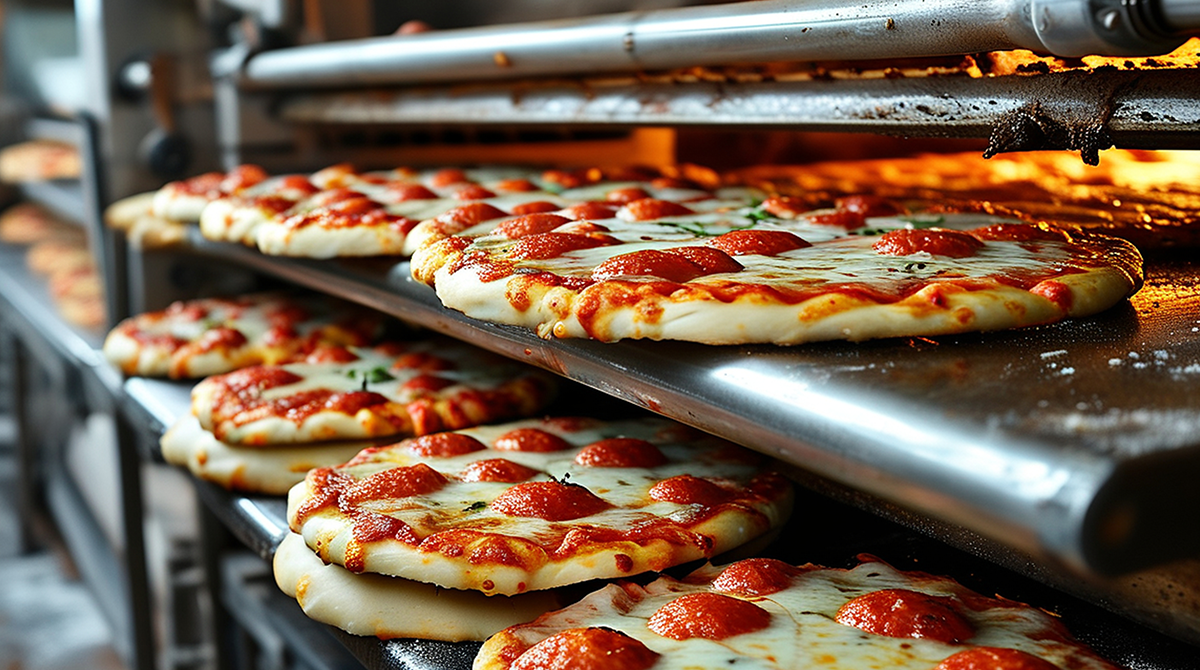
Fast service isn’t limited to in-store orders—delivery is just as important. The ability to prepare pizzas quickly for delivery and takeout is a significant competitive advantage in today’s fast-paced market. Pizza production lines play a vital role in ensuring quick service in delivery models.
Delivery and takeout orders require quick turnaround times to ensure customer satisfaction. Automated pizza production lines help streamline production, allowing for faster preparation and quicker delivery times.
Automated systems help pizzerias manage delivery orders more efficiently. By speeding up the production process, pizzerias can ensure that pizzas are ready for delivery in a timely manner, improving delivery speed and customer satisfaction.
Automated production lines enable businesses to reduce the time between order placement and delivery, which is crucial for maintaining customer satisfaction, especially in competitive markets.
How It Improves Delivery: Fast production speeds ensure that pizzas are made and packaged quickly, reducing overall delivery times and improving customer service.
Many pizzerias and chains are transitioning to delivery-only or "ghost kitchen" models, where the focus is entirely on fulfilling delivery orders. Pizza production lines are ideal for these models, as they can handle high-volume, quick-production needs with minimal labor.
For businesses focused solely on delivery, pizza production lines provide the flexibility and speed needed to operate efficiently. These systems ensure that pizzas are made quickly and consistently, even during peak delivery periods.
For chains operating in multiple locations, automated production lines ensure that pizzas are produced with the same quality and efficiency at each site, providing a uniform customer experience.
How It Supports Delivery-Only Models: Automation makes it easier for delivery-only pizzerias to handle high volumes of orders without hiring additional staff, ensuring operational efficiency and quick service.
In today's fast-paced world, pizza production lines have become a must-have for pizzerias aiming to meet the rising demand for faster service. By automating critical stages of the pizza-making process, these systems enhance speed, improve consistency, and optimize overall production efficiency, allowing pizzerias to serve more customers in less time without compromising on quality.
As customer expectations for quick, convenient service grow, investing in a pizza production line is no longer just a competitive advantage—it’s a necessity. Whether you're managing peak service times, fulfilling large orders, or running a delivery-only operation, automation is the key to providing faster, more efficient service while maintaining high-quality standards.
If you're looking to scale your business and stay ahead of the competition, Shanghal Juheng Food Machinery Equipment Co., Ltd. specializes in custom pizza production lines that can help you achieve just that. With their expert guidance and high-quality machinery, you can streamline your operations and increase your production capacity. Reach out to their team today to learn how they can help your business grow and meet the demands of an ever-evolving market.
Q1: How do pizza production lines help reduce wait times for customers?
Answer: Pizza production lines automate key processes like dough preparation, topping application, and baking, speeding up the overall production cycle and reducing wait times for customers.
Q2: Are pizza production lines customizable for different pizza types?
Answer: Yes, modern pizza production lines are highly customizable. They can be adjusted for different sizes, crust types, and toppings, allowing pizzerias to meet diverse customer preferences.
Q3: How much faster can a pizza production line deliver pizzas compared to traditional methods?
Answer: Pizza production lines can significantly reduce production time, enabling pizzerias to make pizzas in just a few minutes, improving turnaround times and reducing customer wait times.
Q4: Can pizza production lines handle high-demand periods effectively?
Answer: Yes, pizza production lines are designed to scale up production during peak periods. Automation ensures that even during busy times, pizzas can be produced quickly without sacrificing quality.
Q5: What are the benefits of using pizza production lines for delivery-only pizzerias?
Answer: For delivery-only pizzerias, automated pizza production lines improve efficiency by allowing for fast production, ensuring consistent quality, and reducing labor costs, which is crucial for handling high-order volumes.


