

close
Choose Your Site
Global
Social Media
Views: 0 Author: Site Editor Publish Time: 2026-06-03 Origin: Site


Scaling commercial baking operations demands a shift from manual craftsmanship to standardized automation. Buyers often fear compromising dough integrity. They worry about ruining the delicate layers they worked so hard to perfect. This fear holds many growing businesses back. However, manual scaling presents serious roadblocks. You face unpredictable labor costs on a daily basis. Batch-to-batch inconsistency damages your brand reputation. Strict yield limitations prevent you from taking larger wholesale contracts. These factors crush profit margins on high-volume orders.
Investing in a customized pastries production line changes your entire business model. It shifts your operational focus completely. You stop managing daily manual errors. Instead, you focus purely on optimizing throughput and expanding market reach. This transition works beautifully, provided the equipment aligns with your facility's physical footprint. It must also match your strategic goals. In this guide, you will learn how to spot the tipping point for automation. We will show you how to evaluate the right technical dimensions. You will also learn how to navigate adoption risks effectively.
Strategic ROI: Upgrading to an automated line reduces variable labor costs and stabilizes unit economics for high-volume orders.
Uncompromised Consistency: Modern automation ensures precision in dough lamination and resting, crucial for delicate items like puff pastry.
Risk Mitigation: Successful deployment requires upfront evaluation of facility footprint, CapEx tolerance, and recipe adaptability.
Evaluation Focus: Procurement should prioritize modularity, hygienic design, and rapid changeover capabilities over sheer speed alone.
Every expanding food business eventually hits a production wall. Manual labor can only scale so far before quality drops. Identifying this operational bottleneck requires close attention to your daily floor metrics. Symptoms often include soaring scrap rates and rejected batches. You might struggle to fulfill new bulk contract orders on time. Excessive overtime shifts become the norm rather than the exception. Human fatigue sets in during long shifts. This fatigue leads directly to folding errors and uneven portions. When you see these signs consistently, your current process is failing.
At this stage, you must run the math on upgrading. Scaling a manual workforce hides massive ongoing costs. You pay constantly for recruitment, training, and staff turnover. You also pay for inconsistent output. An automated setup replaces these variable human costs with predictable machinery. You swap daily chaos for controlled, measurable production. A modern industrial bakery thrives on predictability. Machines show up every day. They never tire. They follow exact parameters shift after shift.
A successful transition needs clear criteria. Do not automate blindly. Set precise targets for the new equipment before you buy. A good transition looks like this:
Achieve 99% product weight consistency across all daily shifts.
Realize a 30% reduction in raw dough waste and rejected items.
Maintain or improve the internal crumb structure of your baked goods.
Eliminate the need for emergency weekend overtime shifts.
Hitting these specific targets turns your bakery into a reliable manufacturing hub. It gives you the confidence to pitch larger supermarket chains.
Modern equipment brings incredible precision to your factory floor. Automated sensors and calibrated rollers prevent overworking the dough. They monitor dough thickness down to the millimeter. This exactness is non-negotiable for a laminated dough line. You must maintain distinct butter layers without tearing the delicate gluten matrix. Multi-roller systems step down the dough thickness gradually. This "stress-free" handling mirrors gentle manual rolling. It protects the cellular structure of your product. Your butter layers remain perfectly intact.
Balancing speed and quality is a classic operational challenge. Older machines used to destroy delicate dough structures. Today, continuous mixing and resting conveyors synchronize perfectly. They increase your hourly yield without degrading texture. The dough gets exactly the resting time it needs between folds. Retracting belts ensure tension-free depositing. You push out more units per hour while keeping the artisan feel intact. You no longer have to sacrifice quality for speed.
Mechanical consistency also acts as ultimate brand protection. Consumers expect the exact same bite every single time. A reliable pastry machine ensures multi-location franchises receive identical product specifications. You eliminate the variance across different human bakers. A croissant baked in New York tastes identical to one baked in Chicago. This strict uniformity secures major wholesale contracts. It protects your brand reputation in highly competitive markets.
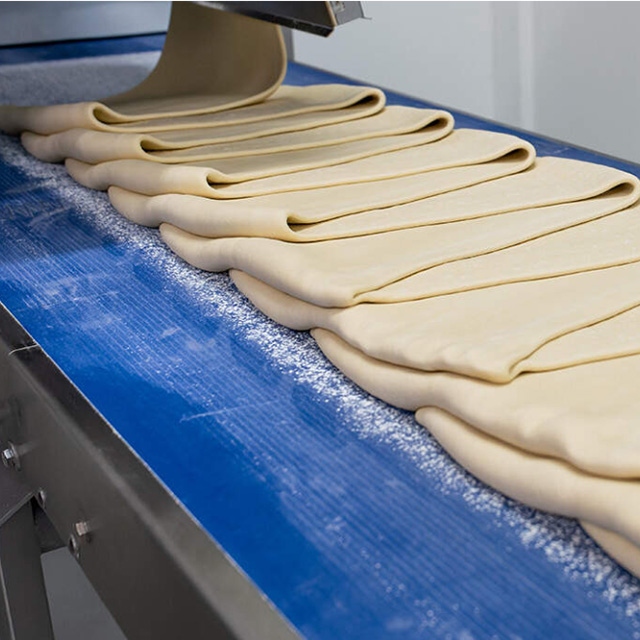
Buying industrial equipment requires rigorous and objective evaluation. Modularity and flexibility should sit at the top of your checklist. Ask yourself if the line can handle multiple different SKUs. Can you quickly switch from crafting croissants to processing specialized puff pastry? Changeover times dictate your daily agility. Look for quick-release tools. Avoid machines requiring heavy wrenches to swap cutting stations.
Next, carefully inspect the hygienic design of the equipment. Food safety compliance is critical for long-term survival. Look for tool-less dismantling features on all conveyors. Insist on washdown-rated components throughout the line. Look specifically for IP69K standard ratings. These designs prevent dangerous bacterial buildup. They allow your sanitation team to use high-pressure, high-temperature water. This drastically cuts down daily cleaning hours. Less cleaning time means more production time.
You must also weigh throughput against your physical footprint. Bigger machines are not always better. An oversized unit might cause terrible workflow bottlenecks elsewhere in the facility. It might overwhelm your current spiral freezers or ovens. Use a structured framework to match machine capacity to available floor space. The table below outlines typical requirements.
Throughput vs. Footprint Comparison Chart | |||
Production Scale | Average Throughput (kg/hr) | Required Linear Space (Meters) | Best For |
|---|---|---|---|
Compact / Modular | 200 - 500 | 8 - 12 | Mid-sized bakeries expanding from manual |
Standard Industrial | 500 - 1,500 | 15 - 25 | Regional distributors, wholesale contracts |
High-Capacity Continuous | 1,500+ | 30+ (Often U-shaped) | National franchises, export-level volume |
Automation is never a plug-and-play magic bullet. It requires real operational adjustment. You must adapt your existing recipes to fit machine tolerances. Machines handle dough differently than human hands do. For instance, you might need to adjust hydration levels slightly. This prevents sticky dough from gumming up synthetic belts. You may also need to source fats with specific plasticity ratings. We recommend being completely transparent about these assumptions early on. The machine changes the process. The recipe must bend to accommodate it.
Beware of hidden secondary costs during installation. Many buyers only look at the initial invoice price. They forget about mandatory facility power upgrades. They ignore necessary HVAC adjustments. High-speed lamination generates heat. You must cool the room aggressively so butter layers do not melt. Specialized operator training also requires a dedicated upfront budget. Your staff needs time to learn the new control panels. You must prepare for these facility expenses before the machine arrives.
Downtime and preventative maintenance are daily realities. Belts wear out over time. Optic sensors drift out of alignment. Bearings need regular food-grade lubrication. You need a highly responsive vendor. Evaluate them strictly based on local parts availability. Check their Service Level Agreement (SLA) response times. A broken main conveyor costs thousands of dollars per hour. Fast engineering support is your only safety net during peak production seasons.
Before contacting vendors, audit your current baseline thoroughly. Document your daily scrap rates meticulously. Track your exact labor hours per batch. Note your peak capacity limits during holiday rushes. This data becomes your strongest negotiation leverage. It tells you exactly what the new setup needs to achieve. Do not guess these numbers. Pull the actual shift logs. Knowing your baseline prevents you from overbuying unnecessary capacity.
Always request a Factory Acceptance Test (FAT). Require the vendor to run the test using your bakery's actual proprietary ingredients. Flour from Europe behaves differently than flour from North America. Water hardness varies by city. Fly your lead baker to the manufacturing facility. Run your specific recipe on their test machine. Prove the concept entirely before signing the final check. If the vendor refuses a custom FAT, walk away immediately.
Create a strict vendor evaluation matrix. Keep it simple and focused on practical integration. Score each vendor on the following crucial elements:
System Integration: Does the machine software communicate easily with your current mixing and proofing systems?
Post-Installation Support: Does the vendor provide on-site engineering support for the first crucial month?
Sanitation Efficiency: How many specific labor hours are required to clean the entire line daily?
Spare Parts Access: Are critical wear parts stocked locally, or do they ship internationally?
Scoring vendors objectively removes emotion from the purchase. It ensures you buy the most reliable infrastructure for your specific daily needs.
Transitioning to automated pastry equipment represents a strategic infrastructure play. It is much more than a simple equipment upgrade. You are fundamentally redesigning how your facility generates revenue. You trade manual unpredictability for mechanical precision. This unlocks the ability to scale your operations securely.
Remember, the best machinery scales a good recipe. It cannot fix a fundamentally flawed one. Take the time to perfect your dough chemistry before automating it. Ensure your team understands the new environmental controls required. Prepare your facility for the physical changes.
Take action today to start this transition. Follow these immediate next steps:
Conduct a full facility footprint audit to identify spatial constraints.
Document your current scrap rates and labor hours to establish a firm baseline.
Request technical spec comparison guides from at least three different equipment vendors.
Demand a custom Factory Acceptance Test using your proprietary ingredients.
A: Most commercial bakeries see a full return on investment within 18 to 36 months. This timeline heavily depends on your initial labor savings and immediate reductions in raw material waste. Your newfound ability to accept high-volume bulk contracts also speeds this up. Running multiple shifts accelerates this payback period significantly.
A: Yes. Modern systems use highly modular tooling and bypass conveyors to handle multiple products. You simply swap out cutting and forming stations. However, you must account for operational downtime during these changeovers. Proper production scheduling minimizes this disruption and maximizes daily machine uptime.
A: The main challenges include synthetic belt wear, optic sensor calibration drift, and bearing lubrication. You must also implement dedicated daily sanitation shifts. Failing to clean thoroughly causes dough buildup. This buildup leads to mechanical jams and severe cross-contamination risks across different production batches.
A: A continuous setup generally demands 15 to 30 meters of linear space. If your facility lacks this length, vendors can design U-shape or L-shape configurations. You must also factor in extra clearance space. Maintenance staff, cleaning carts, and overhead cooling towers all require dedicated room around the machinery.


