

close
Choose Your Site
Global
Social Media
Views: 0 Author: Site Editor Publish Time: 2026-07-04 Origin: Site


Transitioning from semi-manual lamination to a fully automated puff pastry production line for bakery environments demands careful operational planning. You must constantly balance high throughput capabilities with artisan-level dough integrity. Industrial bakeries face a complex core challenge during rapid facility expansion. They must completely eliminate butter bleed, avoid destructive dough tearing, and standardize mathematical layer calculations across every batch. Facility operators also need to manage intense labor dependencies while optimizing their limited factory footprint.
This article provides operations managers, technical directors, and bakery owners with a comprehensive evaluation framework. We will help you confidently shortlist the ideal equipment for your specific production facility. You will learn to properly evaluate lamination precision and dissect complex folding system mechanics. We also extensively cover modularity strategies, international hygiene standards, and critical maintenance criteria. These technical insights ensure your capital investment consistently delivers flawless product quality at a demanding industrial scale.
A reliable lamination dough line must feature stress-free dough sheeting and precise fat pump extrusion to maintain consistent layer geometry.
The mechanical folding system determines the final product volume; evaluating the mathematical layering capabilities (Z-folds, C-folds) is critical before procurement.
Modularity dictates ROI: A system should seamlessly adapt to produce both standard blocks and feed into a specialized filled pastry line.
Long-term equipment viability relies heavily on sanitary design, making washdown-ready, SS puff pastry equipment an industry standard for compliance.
Scaling lamination requires fundamentally shifting focus from manual dough handling to continuous, stress-free dough bands. Manual sheeting often creates uneven mechanical stress across the dough. It inconsistently damages the delicate gluten network. You need continuous, stress-free dough bands to maintain product uniformity. Automated systems manage the dough structure gently. They successfully replicate artisan laminating techniques at exceptionally high industrial speeds. The baseline for modern production demands absolute consistency in dough thickness and width before the fat is even introduced.
When evaluating equipment, you must apply a features-to-outcomes dimension to your selection process.
Dough Banding Systems: Look closely for multi-roller extruders and satellite heads. These specific components reduce dough tension significantly. Multi-roller setups prevent harmful gluten over-development early in the line. They guide and coax the dough forward rather than forcing it through narrow gaps. A stress-free dough bander ensures the foundational dough sheet remains relaxed.
Throughput vs. Footprint: You must rigorously assess modular configurations against your spatial realities. Facilities rarely possess unlimited straight-line floor space. Equipment configured in L-shape, U-shape, or Z-shape layouts fits complex real-world factory floor constraints. U-shape lines maximize critical dough resting time within highly compact building spaces. L-shape lines fit perfectly into corner layouts, optimizing your overall workflow without sacrificing throughput capacity.
Failing to align the continuous mixer output directly with the laminator intake capacity introduces a severe implementation risk. This mismatch leads to massive dough resting bottlenecks. The laminator intake capacity must perfectly match the mixer output volume. If they misalign, the raw dough rests too long in the hoppers. This aggressively over-proofs the dough before lamination even begins, ruining the final texture. We strongly recommend conducting a thorough capacity audit of your mixing room before finalizing any laminator purchase.
The technical requirement for flawless puff pastry is the continuous incorporation of butter or margarine without ever breaking the vital fat barrier. A broken barrier causes extensive butter bleed during the baking phase. It ruins the flaky, delicate texture consumers expect. Maintaining this barrier requires incredibly precise machinery capable of handling varying fat viscosities.
Evaluating fat pump systems involves comparing modern continuous extrusion against outdated manual block feeding. Manual feeding inherently introduces human error into the production cycle. Operators might easily leave small gaps or create overlaps between individual fat blocks. Continuous fat extrusion guarantees a perfectly uniform fat sheet directly on top of the moving dough band.
Evaluation Feature | Continuous Fat Pump System | Manual Block Feeding |
|---|---|---|
Layer Distribution | Uniform, uninterrupted fat layer | Highly prone to gaps and overlaps |
Labor Requirement | Minimal supervision needed | Requires high physical labor |
Temperature Control | Integrated cooling and heating jackets | Dependent on ambient room environment |
Process Consistency | Highly reliable across long shifts | Completely operator dependent |
Temperature control serves as the absolute backbone of successful fat encapsulation. Advanced automated systems monitor fat and dough temperatures simultaneously using infrared sensors. They continuously synchronize these thermal elements. If the extruded fat gets too cold, it literally shatters inside the dough during folding. If the fat gets too warm, it melts directly into the dough matrix, and you lose all distinct pastry layers. High-end equipment utilizes actively water-cooled resting beds. They proactively maintain precise thermal environments across the entire line.
Always request rigorous equipment demonstrations before buying. Vendors should explicitly prove consistent fat distribution capabilities. You should meticulously measure the percentage of fat to dough weight across an entire 8-hour shift. This verification check ensures the fat barrier remains completely intact under continuous mechanical stress.
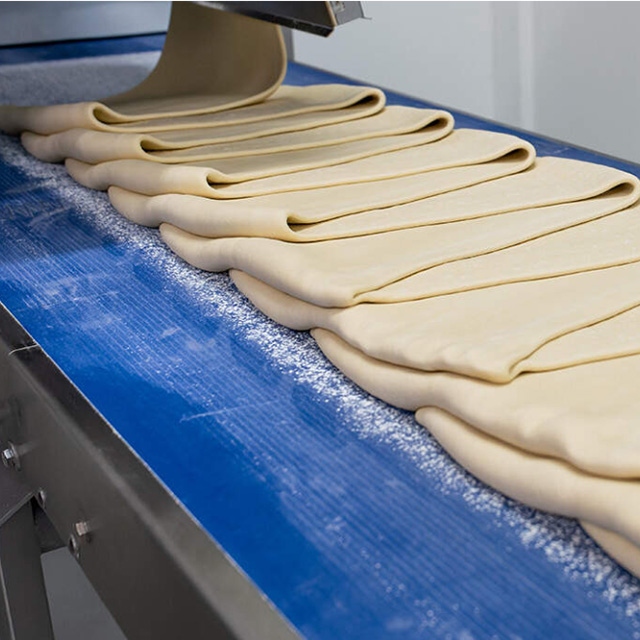
The expertise behind pastry production relies heavily on strict layer mathematics. Automated folding mechanisms effectively multiply layers exponentially through precise mechanical motions. Different fold types yield distinctly different volume results. A standard 3-fold creates three distinct layers per mechanical station. A 4-fold creates four layers. If you configure a line with three sequential 4-fold stations, you instantly generate 64 continuous fat layers. This mathematical compounding formula dictates the final product volume, height, and crumb structure.
Mechanical evaluation requires focusing on how the machinery handles the dough physically.
Cross-Rolling Stations: Multi-directional rolling remains absolutely critical. It deliberately maintains equal dough shrinkage horizontally and vertically. Without it, your pastries will deform wildly during the baking process. Oval or misshapen croissants always result from improper cross-rolling tension.
Retracting Belts vs. Swing Folders: Your mechanism choice heavily impacts dough integrity. Retracting belts drop the dough layers gently onto the lower conveyor. Swing folders whip the continuous dough back and forth aggressively. Retracting belts significantly reduce mechanical stress. They prevent microscopic tearing at the folded edges. We strongly advise choosing retracting systems for handling delicate, high-fat dough formulations.
Implementation considerations must heavily feature automated resting conveyors. Lamination aggressively reduces dough thickness in a very short timeframe. Severe, rapid thickness reductions build immense internal kinetic tension within the gluten strands. You must ensure the chosen system allows sufficient relaxation time between major reduction stations. Resting conveyors move the dough slowly through specialized climate-controlled zones. This effectively prevents dough recoil when the final product is cut. If your dough violently shrinks immediately after cutting, your inline resting time is severely insufficient.
Moving beyond basic bulk dough blocks unlocks massive profitability for bakeries. You want to produce fully finished consumer products ready for retail. Scalability and modularity ultimately define a highly effective industrial pastry line. You should deliberately configure the line for seamless, rapid downstream integration.
Integration capabilities separate premium lines from basic sheeters. You can easily add complex make-up tables directly to the main outfeed. You might integrate heavy-duty guillotines for precise, high-speed length cutting. Many facilities add stamping units for distinct, custom pastry shapes. The ultimate goal remains a continuous, uninterrupted flow from raw flour mixing directly to a fully formed pastry.
Transitioning from a plain laminated sheet to a complex finished product requires highly specific attachments. You can easily feed the continuous dough into a specialized filled pastry line. This transition involves integrating highly accurate volumetric depositors. They accurately portion fruit, pastry cream, or dense savory fillings. A properly synchronized timing belt ensures these fillings hit the exact mathematical center of the dough pad every single time.
Your shortlisting logic should always prioritize vendors utilizing modular tool-swapping methodologies. Quick changeovers keep your production line running profitably. You want the ability to switch from standard croissants to long puff pastry sticks rapidly. Tool-free locking mechanisms vastly reduce daily downtime. Look closely for make-up stations mounted on independent mobile frames. Operators can simply roll them in and out as the daily product runs change.
Regulatory compliance remains strictly mandatory in automated food processing. You must rigorously evaluate all machinery against FDA, CE, and EHEDG design standards. These authoritative bodies dictate safe sanitary design principles to prevent foodborne illness outbreaks across factory environments.
Evaluating the equipment build quality requires an uncompromising approach. Heavy-duty, food-grade stainless steel is completely non-negotiable for longevity. Premium SS puff pastry equipment reliably survives harsh chemical washdowns every single day. You must actively look for open-frame machine designs. Closed structural tubes often trap residual moisture and harbor bacteria. Open frames deliberately eliminate hidden bacterial harborage zones entirely.
Other essential build requirements include:
Quick-release conveyor belts designed for ultra-fast daily sanitation protocols.
Easily accessible flour scrapers designed for simple daily cleaning and rapid replacement.
Angled and sloped surface planes designed specifically to prevent chemical water pooling.
Maintenance risk mitigation ensures your line operates smoothly for decades. Proprietary replacement belts pose significant, often overlooked operational risks. If a custom belt tears unexpectedly, you need immediate access to replacements. Waiting three weeks for a proprietary overseas belt completely stops your production. Always choose systems utilizing standard, locally sourced modular components. You must also evaluate drive motor accessibility. Maintenance teams must reach all drive systems safely and quickly. Carefully review the vendor's Service Level Agreement (SLA). Demand strict contractual guarantees regarding spare parts availability. Fast SLA responses directly keep your production lines moving smoothly.
An exceptionally effective puff pastry line investment hinges on precise fat encapsulation mechanisms. It requires stress-free mechanical folding logic and expansive modular adaptability. Scaling up production volume should never force you to compromise the delicate, flaky layer structure of your dough. A well-engineered line handles volume while maintaining strict artisan quality.
We recommend taking these action-oriented next steps:
Structure a highly detailed Request for Proposal (RFP) outlining your specific throughput requirements and spatial dimensions.
Always request a comprehensive capacity audit from potential manufacturers before signing any agreements.
Conduct a rigorous dough-testing trial run using your exact fat and flour blend on their factory demo machinery.
Thoroughly verify the machinery's sanitation ease before committing to any major capital expenditure.
A: The calculation uses a simple compounding formula based on your folding stations and fold type. A 3-fold triples the layers, while a 4-fold quadruples them. If you run dough through three 4-fold stations, the math is 4 x 4 x 4, resulting in 64 fat layers. You multiply the baseline dough and fat layers through each active station.
A: Yes, automated lines easily handle both butter and margarine. However, they require adjustable fat pumps to accommodate different viscosities. Because butter and margarine have distinct melting points, the equipment must feature responsive cooling tunnels. This thermal control prevents lower-melting-point fats like butter from liquefying and bleeding into the dough layers during processing.
A: A fully automated line typically requires 15 to 30 meters of floor space. The exact footprint depends heavily on the necessary resting stations and production volume. Manufacturers overcome space limitations by using customized floor planning. They configure the conveyors into L-shape, Z-shape, or U-shape layouts, maximizing dough resting time while minimizing the overall linear footprint.
A: Retrofitting is entirely feasible if your existing laminator features compatible belt synchronization software. You can add modular make-up stations, volumetric depositors, and folding shoes directly to the outfeed. The critical factor is ensuring the control panels communicate properly. Seamless software integration prevents dough jams and ensures precise filling deposition at high speeds.


