

close
Choose Your Site
Global
Social Media
Views: 0 Author: Site Editor Publish Time: 2026-07-05 Origin: Site


Scaling artisanal pastry production presents a unique challenge for growing operations. You must transition from manual lamination to high-volume output. Doing this without sacrificing the delicate honeycomb crumb structure requires extreme care. Manual sheeting and shaping often lead to inconsistent batches. They also drive up labor expenses significantly. Integrating a commercial-grade croissant making machine for bakery operations solves this problem. It standardizes dough lamination, cutting, and forming across every single batch. You gain predictability while protecting product quality.
This objective guide will help you evaluate and implement commercial production equipment. You will learn how to align these mechanical systems with your specific yield requirements. We will explore configuration options, hygiene standards, and operational realities. Read on to master the transition from artisan hands to mechanical precision.
Upgrading to an automatic croissant line reduces labor dependency while standardizing pastry weight, butter distribution, and visual consistency.
Buyers must evaluate equipment based on roller precision, hygiene standards (SS materials), and modularity (standalone sheeters vs. end-to-end forming lines).
Successful implementation requires factoring in facility temperature control, floor space, and operator training to prevent dough tearing or butter bleeding.
Consumer-grade alternatives or repurposed equipment (e.g., pasta rollers) cannot replicate the precise tension and temperature control required for professional lamination.
Every growing facility reaches a distinct operational bottleneck. You will quickly identify when manual sheeting limits your capacity. Hand-rolling requires immense physical labor and constant attention to detail. Human operators naturally fatigue over long shifts. This fatigue leads to uneven dough thickness. It also limits your daily production volume. Recognizing this bottleneck is the first step toward improving profitability.
You must evaluate your current cost-to-yield ratio. Analyze the labor hours spent on manual lamination. Compare these ongoing costs against the production output gained by an automated system. Skilled bakers spend hours turning dough blocks. An automatic croissant line performs these same turns in minutes. This shift allows you to reallocate skilled labor to quality control and recipe development. Efficiency improves drastically when machines handle the repetitive heavy lifting.
Product consistency remains a primary driver for mechanical upgrades. Manual lamination introduces human error during the butter block incorporation phase. We call this the beurrage stage. Uneven butter distribution causes dense spots or massive air pockets in the baked pastry. Mechanical lamination eliminates these fluctuations. Precise rollers apply exact pressure to the dough. They ensure uniform flakiness across all wholesale batches.
Waste reduction provides another major operational benefit. Manual cutting inevitably leaves odd-shaped scraps. Human hands cannot consistently cut identical triangles out of massive dough sheets. Automated systems use calibrated cutting rollers. They slice through the dough layer effortlessly. This precision minimizes dough scrap. It drastically lowers the number of rejected pastries at the end of the line.
You can choose from several equipment configurations based on your volume. Standalone dough lamination machines serve as the entry point. We often refer to these as sheeters. They work best for mid-sized operations. These bakeries need precise thickness control but prefer to maintain hand-shaping techniques. When evaluating sheeters, focus on the belt width. You should also look for reversible operation mechanics and variable speed settings. These features give operators total control over the lamination pace.
Your next configuration level involves dedicated shaping equipment. The croissant forming machine handles the final production phases. It takes over after the lamination process finishes. This specific machine manages the cutting, turning, and rolling phases. It remains crucial for achieving consistent shape. It creates the perfect tension in the final roll. It does this gently. It will not degas the dough before proofing.
Large-scale operations require a completely unified approach. The fully integrated system connects every step seamlessly. These end-to-end setups include continuous dough sheeting and fat pumps. They handle laminating and forming without manual transfers. We consider this the standard wholesale croissant line solution. Engineers design these massive lines for high-volume facilities. They comfortably produce thousands of uniform units per hour.
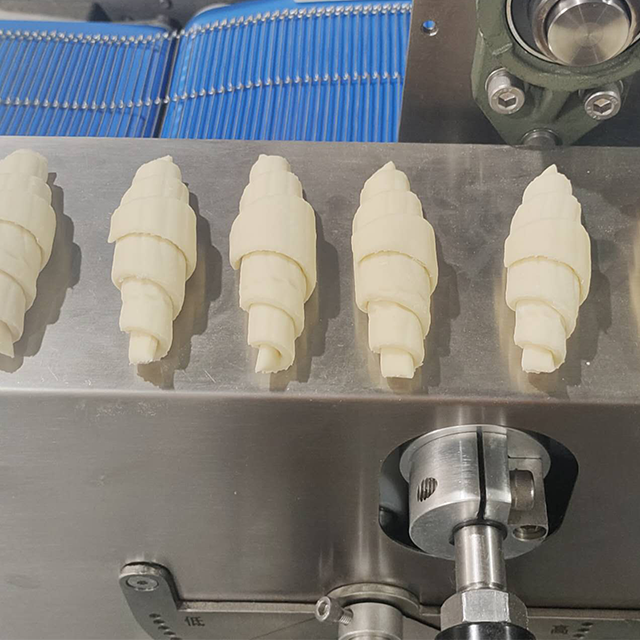
You must assess the calibration unit's ability to reduce dough thickness gently. We call this roller precision. High-quality rollers preserve dough integrity. They stretch the gluten network without tearing it apart. Aggressive reduction causes severe structural damage. It also melts the delicate butter layers through excessive friction. Precise gap adjustments are strictly necessary for perfect crumb architecture.
Hygiene and compliance standards non-negotiable in commercial environments. You should insist on food-grade construction materials. An SS croissant line utilizes high-quality stainless steel throughout its framework. Stainless steel resists corrosion from damp dough and cleaning chemicals. You must also evaluate the accessibility of all moving parts. Look for removable scrapers and quick-release belts. These features enable rapid wash-down procedures. They actively prevent dangerous bacterial buildup.
Modularity determines how your equipment adapts to future growth. A versatile croissant making machine provides expansion opportunities. Can you upgrade it later? Look for systems offering bypass tables. You might want to add extra cutting rollers down the road. This modularity lets you produce other laminated pastries. You can easily switch to making pain au chocolat or danishes on the exact same belt.
Digital controls and programmability streamline daily operations. Advanced equipment features integrated Programmable Logic Controllers (PLCs). The digital interface stores multiple recipe profiles. You can save specific thickness settings, belt speeds, and cutting dimensions. Operators simply press a button to load a profile. This digital memory ensures lightning-fast changeovers between different product lines.
Equipment Comparison: Manual vs. Automated Systems | ||
Evaluation Dimension | Manual / Entry-Level | Automated / Commercial Lines |
|---|---|---|
Roller Precision | Inconsistent pressure; relies on operator feel. | Micro-calibration via digital servo motors. |
Hygiene Standards | Basic wipe-down; exposed belts trap debris. | Full SS construction; quick-release components. |
Modularity | Fixed function; difficult to upgrade. | High flexibility; bypass tables and modular cutters. |
Recipe Memory | None. Operators use manual dials. | Stores dozens of unique PLC recipe profiles. |
Calculating the true facility footprint requires careful spatial planning. Many buyers only measure the machine itself. This is a common mistake. You must account for the entire working area around the conveyors. Operators need room to move. You also need dedicated space for dough resting stations and mobile racks. Always consult the manufacturer's footprint schematics before knocking down walls.
Temperature management often surprises new operators. Automated equipment generates significant mechanical friction. High-speed rollers create heat. This heat transfers directly into your delicate dough. You must evaluate your ambient room temperature. Many facilities require dedicated climate-controlled production rooms. Others install internal cooling conveyors directly onto the machine. These cooling systems prevent butter melt during rapid lamination.
The operator learning curve represents a major transition period. Your staff must shift from using manual feel to relying on digital calibration. It takes time to trust the machinery. Vendor-provided training is absolutely necessary. Instructors teach your team how to program exact tension adjustments. They also demonstrate how to troubleshoot common dough jams safely.
You must establish realistic expectations regarding maintenance downtime. Industrial machines require daily attention. They do not run endlessly without care.
Daily Cleaning: Complete removal of flour dust and butter residue from all sensors and cutting blades.
Belt Inspection: Checking the canvas or polyurethane belts for fraying, slack, or uneven tracking.
Lubrication: Applying food-safe lubricants to specific mechanical chains and drive gears as per the manual.
Motor Servicing: Scheduling quarterly evaluations of servo motors to prevent unexpected electrical faults.
Conducting a Factory Acceptance Test (FAT) is your most vital procurement step. You should never buy complex lamination equipment blind. A successful FAT requires you to test the machine in person. You must use your specific dough formulation. You must use your preferred butter recipe. Flour hydration and butter rheology vary wildly globally. A machine handling European butter beautifully might struggle with a different fat content. The FAT proves the equipment handles your exact ingredients without compromising quality.
Service Level Agreements (SLAs) determine your long-term success. Machines break down. Belts snap. Sensors fail. When these events occur, production halts completely. You must evaluate the vendor's responsiveness before signing any contract. Ask about spare parts availability in your specific region. Does the manufacturer employ local technicians? Review the warranty terms meticulously. A cheap machine becomes incredibly expensive if you wait three weeks for a replacement gear from overseas.
Vendor Assessment Chart | ||
Vendor Metric | Standard Requirement | Premium Indicator |
|---|---|---|
FAT Availability | Virtual demonstration with generic dough. | In-person testing using buyer's exact formulation. |
SLA Response Time | 48-hour email support response. | 24/7 technical hotline with localized dispatch. |
Parts Network | Parts shipped from central global hub. | Regional warehouses stocking critical wear parts. |
Training Delivery | Digital manuals and video tutorials. | On-site engineering team for installation week. |
Investing in commercial lamination technology marks a critical milestone for your wholesale growth. The machinery drastically elevates consistency and output speed. It mitigates the physical strain on your baking staff. However, success depends entirely on selecting equipment matching your specific volume requirements and space constraints. Over-investing creates unnecessary complexity. Under-investing leads to rapid machine burnout.
Your next step requires immediate internal analysis. Map your current daily production volume accurately. Calculate your maximum available floor space, including necessary operator walkways. Once you document these metrics, begin requesting technical data sheets. Schedule demonstration runs and FAT sessions with your shortlisted manufacturers. Proper preparation ensures your transition to mechanical lamination yields beautiful, flaky results every single time.
A: No. While often discussed in amateur baking forums, pasta rollers lack the width, micro-calibration, and gentle handling required for laminated pastry. They apply harsh, direct pressure. They will crush the delicate butter layers completely. This aggressive friction destroys the final honeycomb structure. Pasta rollers cannot process yeast-leavened laminated dough successfully.
A: A dough sheeter simply flattens the dough and butter into thin, even layers. We call this process lamination. A forming machine performs entirely different tasks. It takes that finalized laminated dough, cuts it into precise triangles, and mechanically rolls it. It handles the classic crescent shape formation post-lamination.
A: Space requirements vary significantly based on configuration. A standalone reversible sheeter may need only 2 to 3 meters of linear working space. Conversely, a fully automatic continuous line can easily require 10 to 20+ meters. You must always consult the manufacturer's official footprint schematics before planning your layout.
A: High-quality commercial machines mimic the gentle tension of skilled hand-rolling. They preserve texture beautifully. However, poorly calibrated equipment can ruin the product. It can roll the dough triangles too tightly. This excessive tension prevents proper proofing, resulting in a dense, heavy crumb. Proper initial testing and daily calibration remain essential.


