

close
Choose Your Site
Global
Social Media




| Quantity: | |
|---|---|


JH3168
Shanghai Juheng
Mode | JH1801 |
| Dimension | 31118*1550*1648 (mm) |
| Capacity | 1000kg/h |
| Power specification | 380V, 50HZ, 3PH, 21KW |
| Material | SUS304, PE |
| Finished product | Unbaked, frozen |
| Product size | Adjustable |
Available in fully automated and semi-automated configurations, the line balances efficiency, flexibility, and cost-effectiveness. At its core, precision shaping and layering technology ensure each paratha retains its signature crisp-yet-tender layered texture after freezing, storage, and home preparation. Constructed with SUS304 stainless steel and food-grade PE materials, the line complies with global hygiene standards, while adjustable settings support regional taste preferences such as spiced, herb-infused, or plain Lachha Parathas.Available in fully automated and semi-automated configurations, the line balances efficiency, flexibility, and cost-effectiveness. At its core, precision shaping and layering technology ensure each paratha retains its signature crisp-yet-tender layered texture after freezing, storage, and home preparation. Constructed with SUS304 stainless steel and food-grade PE materials, the line complies with global hygiene standards, while adjustable settings support regional taste preferences such as spiced, herb-infused, or plain Lachha Parathas.

Production process
Step 1: Dough Feeding & Initial Sheeting
The mixed dough is loaded into the dough hopper and fed into the first stage of multi-roller sheeting. The dough is
progressively reduced in thickness through multiple sheeting stations, transforming from a thick dough mass into a
continuous dough sheet.
Step 3: Precision Stretching
The dough sheet enters the stretching mechanism, which expands the sheet horizontally to an ultra-thin thickness
of approximately 0.8–1.0mm. This stretching creates the thin membrane structure essential for authentic Lachha
Paratha layers.
Step 4: Oil/Ghee Application
Automated oiling devices apply a uniform layer of oil or ghee onto the stretched dough sheet from both above and
below. For flavored variations, additional ingredients (chopped scallions, cumin etc.) can be sprinkled on at this
stage.
Step 5: Layer Folding & Cutting
The oiled dough sheet is rolled up into a multi-layered strip. The rolled strip then passes through a cutting station
that divides it into individual portions at precise weight intervals.
Step 6: Rolling into Dough Balls
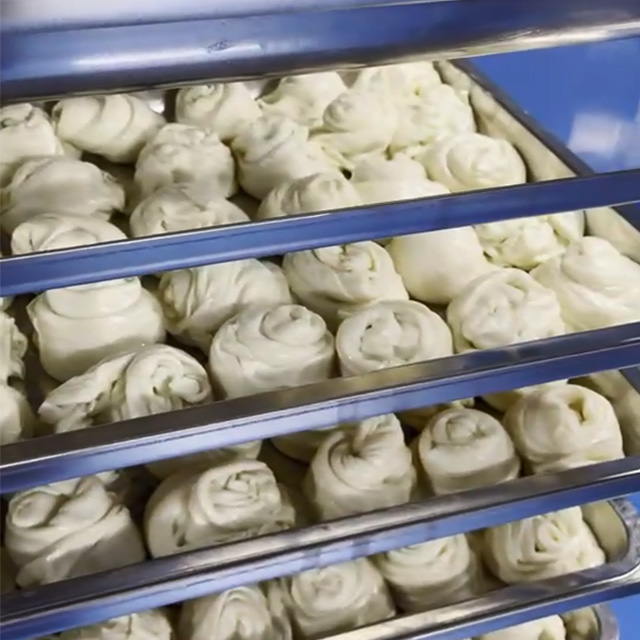
Each dough portion enters a coiling device that twists and rolls it into a spherical dough ball. This preserves the
layered structure for the final pressing stage.
Step 7: Pressing into Dough Discs
The dough balls are pressed into flat discs using a high-precision pressing machine. If required, an automatic filming
system can apply plastic film above and below each disc to prevent sticking during frozen storage and transport.
Step 8: Freezing & Packaging
Finished dough discs enter a freezer for rapid freezing, locking in freshness and preserving the layered structure.
The frozen discs are then automatically packaged, metal-detected, weight-checked and boxed.
Precision-engineered shaping and layering mechanisms ensure uniform thickness and flakiness, even after freezing and end-user cooking (pan-frying or baking). This guarantees layers separate beautifully without becoming greasy—a key characteristic of authentic Lachha Parathas.
Automated processes eliminate human variability, ensuring every dough disc meets the same high standards for texture, appearance, and weight, reducing product waste and customer complaints.
Available in fully automated and semi-automated models, allowing businesses to choose a configuration that matches their budget, factory size, and labor resources.
Modular design supports easy upgrades (e.g., adding a dough divider or stacking module) as business grows, avoiding the need for full equipment replacement when scaling production.
Boasts a capacity range of 5500-8600pcs/h (adjustable based on paratha size) and operates on a 380V, 50HZ, 3PH power supply with a total power of 21KW, balancing high output with energy efficiency.
Adjustable settings for dough weight and szie, and layering density, enabling customization to match regional preferences.
Supports the addition of spices (e.g., cumin, coriander), herbs (e.g., mint, cilantro), or chopped vegetables (e.g., scallions, grated carrots) during dough preparation, allowing for a diverse product portfolio that caters to niche markets.
Ideal for mass production of frozen Lachha Paratha dough discs to supply retail stores, online grocery platforms, and food service providers. The line’s high capacity ensures efficient fulfillment of large orders, while its frozen output extends shelf life for broad distribution.
Provides standardized, ready-to-cook paratha dough for Indian restaurants, fast-food chains, and catering services. Uniform quality across all outlets ensures customers receive the same flaky paratha at every location, strengthening brand consistency.
Meets international standards for frozen food hygiene and quality, making it suitable for exporting to global markets (e.g., Europe, North America, or Southeast Asia). Its ability to adapt to regional tastes and size preferences enhances competitiveness in diverse markets.
Capacity ranges from 5500-8600pcs/h, with smaller parathas yielding higher output and larger parathas reducing throughput slightly. Our team can calculate exact capacity based on your product specifications.
To tailor the line to your business, please provide:
Target paratha size (diameter, weight, and thickness).
Desired production capacity (hourly or daily output goals).
Factory layout (available space, integration with existing freezing equipment, and utility access).
Any specialized requirements (e.g., spice addition, gluten-free dough handling).
The production cycle is approximately 2 months, shorter than many industry counterparts, though this may extend slightly for complex customizations (e.g., adding a vegetable mixing module).
We provide a 1-year warranty covering all core components, including shaping mechanisms, conveyors, and control systems. Warranty service includes free part replacement and technical support for issues from normal use.
Payment is accepted via T/T or L/C. The terms require 40% of the total amount as a deposit to start production, with the remaining balance due before delivery.


