

close
Choose Your Site
Global
Social Media
Views: 0 Author: Site Editor Publish Time: 2026-06-17 Origin: Site


Producing traditional flatbreads at a commercial scale presents a massive operational friction for modern food manufacturers. Hand-crafting artisanal dough involves intensive labor. It requires precise lamination, accurate portioning, and delicate handling. Kitchen teams often find that manual folding maxes out at dozens of pieces per hour. However, commercial retail and foodservice contracts demand thousands.
This massive gap creates a scaling bottleneck. You cannot simply throw more human labor at the problem without sacrificing consistency and profitability. The transition to automation becomes essential. A commercial scallion pancake line serves as the necessary bridge. It maintains authentic artisanal quality, preserving gluten integrity and delicate lamination, while delivering high-volume outputs.
This guide provides plant managers, central kitchen operators, and food manufacturers with an evidence-based framework. We will explore how you can evaluate, implement, and expand your product lines using these advanced mechanical systems.
Capacity vs. Quality: Modern systems achieve outputs of 2,100 to 5,000 pcs/hr while replicating manual "cinnamon roll" style folding to create up to 32 distinct flaky layers.
Expanded Applications: Beyond traditional Asian appetizers, these lines enable the production of fusion flatbreads, wrap bases, and stuffed pastries without changing core equipment.
Risk Mitigation: Automatic top-and-bottom film pressing resolves the notorious "freezing stickiness" issue that plagues semi-automated raw dough storage.
ROI Drivers: Precise automated sprinkling and 4-wheel dough pressing reduce raw material waste and cut labor dependencies by up to 70%.
Kitchen operations rely heavily on consistency. However, manual production introduces severe limits when scaling up flatbread manufacturing. Traditional dough preparation requires time-consuming hot-water resting. If you rush this step, the dough loses its essential elasticity. Manual oil distribution remains inconsistent at best. Some pieces receive too much fat, while others dry out during cooking.
The inability to prep large frozen batches manually is another major pain point. When operators freeze raw dough manually, the pieces often stick together. They degrade rapidly upon thawing. Deploying a fast production line directly mitigates these logistical nightmares.
Manual lamination inherently limits output. It introduces constant human error into ingredient portioning. Dropped scallions and over-poured oil drastically increase raw material waste. This wasted material bleeds profit margins daily. Automation solves these cost and consistency realities. It strips the unpredictability out of your overhead calculations.
You must view the automation advantage as more than just a speed upgrade. It operates as an ultimate standardization tool. Machine-controlled resting, often called proofing, stabilizes the dough structure. Equipment can achieve a consistent 0.6mm to 0.8mm dough stretch every single time. This uniformity locks in the authentic flavor and delicate texture that your customers expect.
Skipping the necessary hydration phase to speed up prep time.
Using improper freezing materials, leading to unpeelable dough blocks.
Overworking the gluten network during manual lamination, causing tough flatbreads.
Investing in commercial equipment requires versatile applications. A single production setup must handle varied product demands to maximize your return. Modern equipment far exceeds the production of just one niche appetizer.
The primary use remains standard traditional items. The machinery expertly portions dough into variable weights ranging from 40g to 150g. You can seamlessly produce the classic green onion pancake with perfectly distributed inclusions. The equipment also crafts delicate Lacha Paratha and shredded flaky pancakes. It maintains the distinct pull-apart texture essential to these regional specialties.
Culinary trends increasingly blur geographic lines. Manufacturers use these machines to capitalize on global fusion concepts. You can produce uniform flatbreads utilized as modern taco or burrito wrappers. Restaurants heavily demand these items as innovative bases for "BEC" (bacon, egg, and cheese) breakfast sandwiches or trendy burger buns.
Gourmet variations are entirely possible. You can adapt the line to process sourdough-based flatbreads. Operators frequently incorporate specialized fats like premium butter or vegan margarines to target high-end consumer niches.
Transitioning from a basic Chinese flatbread to a filled product requires minimal disruption. You achieve this through modular add-ons. By integrating automated filling depositors, the exact same continuous line produces complex items. You can manufacture red bean pastries, savory meat pies, or intricate curry puffs. This flexibility maximizes your equipment utilization across multiple shifts.
Replacing skilled human hands with metal rollers requires precise engineering. Buyers must understand how automated mechanics replicate centuries-old culinary techniques without sacrificing quality.
Progressive Dough Thinning: The system utilizes a necessary 4-consecutive-roller design. Evaluators must look for machines that gradually flatten the dough. It should reach approximately 1mm in thickness. Gradual reduction prevents tearing and preserves the fragile gluten network.
Lamination & Layering: Achieving the famous "snail" shape is paramount. An advanced pulling and folding device handles this step. The equipment rolls the oiled, sprinkled dough into a long log. It then coils it precisely. This specific mechanical action guarantees up to 32 distinct flaky layers.
Precision Ingredient Application: Manual sprinkling causes massive waste. Look for patterned sprinklers and automated fat-extruders. They handle margarine and oil with exact recipe parameters. This eliminates ingredient bleed on the conveyor belts.
The Crucial Resting Phase: Traditional recipes demand patience. Quality machines feature an integrated 10-minute proofing conveyor sequence. This occurs right before the final pressing. It allows extruded fats to coagulate properly within the dough layers. This remains a non-negotiable step for achieving an authentic, crispy texture.
Choosing an automated pancake system with these exact mechanics ensures you never compromise on the artisanal bite.
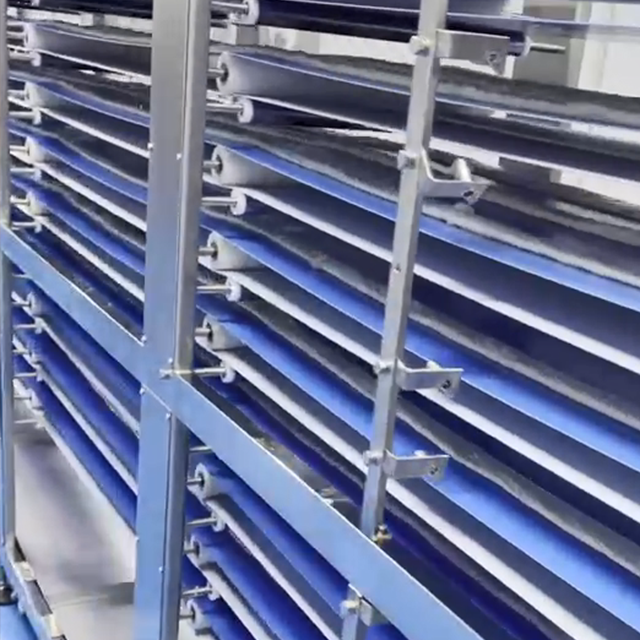
Procuring heavy food machinery demands a strict evaluation framework. You must balance physical facility constraints with aggressive output goals.
First, consider throughput versus footprint. You must match your facility size with actual machine output capacities. The current industry benchmark sits at roughly 3,000 pieces per hour, or about 300kg per hour. Assess whether your factory floor requires a straight-line setup or an L-shape configuration to accommodate the conveyors.
Film wrapping and pressing integration represent the most critical technical feature. The line must feature automatic top-and-bottom filming. It must use food-grade materials exactly during the final press. This action seals the raw dough instantly. It allows you to integrate the product directly into blast freezing or packaging lines. It permanently eliminates the dreaded dough-sticking failure that ruins manual batches.
Component reliability and regulatory compliance safeguard your investment. Scrutinize the origins of core internal components. Check the brands of the PLC controllers and servo motors. Ensure the entire frame utilizes food-grade stainless steel construction. Furthermore, modern lines should feature CE or ISO certifications. We highly recommend looking for IoT (Internet of Things) capabilities. Real-time yield monitoring and predictive maintenance tracking keep your line running smoothly.
Process Factor | Manual / Semi-Auto Method | Automated Line Standard | Key Business Benefit |
|---|---|---|---|
Dough Sheeting | Hand rolling or single-pass sheeter | 4-consecutive-roller progressive thinning | Maintains gluten integrity; consistent 0.8mm thickness. |
Lamination | Hand folding and coiling | Mechanical pulling & folding ("Snail" coil) | Guarantees exact layer counts (up to 32 layers). |
Ingredient Application | Manual scattering and brushing | Patterned sprinklers & fat-extruders | Zero waste; exact per-unit flavor profile. |
Product Isolation | Layering with wax paper by hand | Automatic top-and-bottom film pressing | Prevents freezer burn and unpeelable sticking. |
Buying the equipment marks only the beginning. Successful deployment requires careful facility preparation and strategic downstream integration.
Assess your facility requirements early. You must verify adequate voltage supply, correct pneumatic air pressure, and drainage access. Floor plan layouts matter immensely. Collaborate with your vendor to determine if an L-shape or a straight-line setup best optimizes your existing square footage.
Next, define your downstream processing. You must make the crucial "par-cook" versus raw-freeze decision. Some operations pass the fully pressed, filmed cakes directly into blast freezers for retail sale. Others route the bare dough through a continuous commercial fryer. This creates a semi-cooked, or par-cooked, product highly favored by quick-service restaurants.
Finally, prioritize training and vendor support. Emphasize partners who offer true turnkey planning. They should assist with recipe formulation testing to adapt your specific hydration levels to their machinery. Never sign a purchase order without conducting an on-site video inspection or a comprehensive FAT (Factory Acceptance Testing) process before the equipment ships.
Investing in specialized flatbread automation transforms chaotic kitchen prep into a highly predictable manufacturing process. You secure definitive control over every variable. You lock in precise dough thickness, optimal layer counts, and exact ingredient ratios. Most importantly, you drastically lower your per-unit production costs while maintaining premium artisanal quality.
To move forward successfully, take these immediate next steps:
Request detailed floor plan CAD layouts from potential vendors to verify spatial compatibility.
Conduct physical or virtual product trials using your exact proprietary flour and fat formulations.
Audit your downstream freezer and fryer capacities to ensure they can handle a 3,000 pcs/hr influx.
Review the PLC software interface to confirm rapid recipe changeover capabilities.
A: Most industrial buyers see full ROI within 12 to 18 months. This timeline relies heavily on labor reduction metrics. Upgrading to an automated system typically highlights a 70% decrease in manual handling. The drastic reduction in payroll and minimized raw ingredient waste quickly balances against the initial capital expenditure.
A: Yes. Quality lines are specifically engineered to process traditional high-moisture Chinese doughs. They utilize non-stick continuous belts, specialized dusting mechanisms, and progressive rollers. This prevents sticky hot-water dough from tearing or jamming the production sequence.
A: The equipment features an automated dual-sided film pressing module. During the final flattening stage, the machine applies top and bottom food-grade film. This physically isolates each unit prior to stacking and freezing, entirely eliminating fusion and sticking.
A: Absolutely. Modern lines utilize PLC memory for instant recipe presets. You can adjust the dough stretching speed, ingredient extrusion rates, and cutting lengths via a touchscreen. Physical changeover time for cutting molds or weight adjustments generally takes less than 20 minutes.


