close
Choose Your Site
Global
Social Media


| Quantity: | |
|---|---|


JH1688
Shanghai Juheng
Model | JH1688 |
| Dimension | 21193mm*1926mm*1632mm |
Bread size | Adjustable |
| Capacit | 3600-4200pcs/h |
Power specification | 380V, 50HZ, 3PH, 20KW |
The Juheng Semi-Automatic Stuffed Paratha Production Line employs a unique continuous roll-forming process that fundamentally differs from conventional edge-sealing methods. Instead of wrapping filling inside a dough pocket and crimping the edges, this system stretches the dough into a thin sheet, deposits a continuous line of filling along one edge, rolls the dough around the filling into a tight cylinder, then clamps and cuts the cylinder into individual filled dough balls. A final film-covering and pressing stage transforms each ball into a perfectly round, uniformly thick paratha disc.
This roll-forming approach offers distinct advantages: no edge seals that can rupture during freezing or cooking, no filling leakage, consistent filling distribution from center to edge, and gentle handling that preserves filling texture — particularly important for chunky fillings like spiced potato or minced meat.
The line handles the complete process from dough sheeting through finished disc output. All food-contact surfaces are food grade material with central PLC control.
Suitable for frozen food manufacturers, central kitchens, and export-oriented facilities producing filled flatbreads for retail and foodservice channels worldwide.
The line accepts pre‑mixed standard dough. The process combines fully automated stages with operator‑assisted steps for optimal dough relaxation and product quality.
Advantages
Continuous Roll-Forming Technology: No edge seals, no fold lines, no leak paths — filling is continuously enclosed within a rolled dough cylinder.
Uniform Filling Distribution: Every paratha has consistent filling from center to edge, unlike pocket-style methods where filling settles in the middle.
Clamp-Cut Precision: Pneumatic clamping cuts the filled cylinder cleanly while naturally pinching the ends closed — no secondary sealing step required.
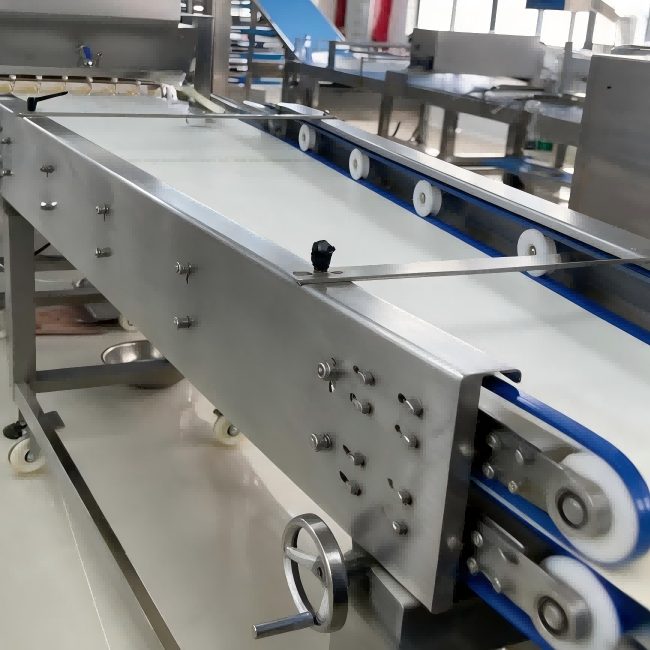
Full SUS304 Construction: All food-contact surfaces is SUS Stainless Steel and food grade conveyor belt.
Ideal for mass production of frozen stuffed parathas to supply retail stores, online grocery platforms, and food service providers. The line’s high capacity and consistency ensure efficient fulfillment of large orders, while frozen output extends shelf life for broad distribution.
Provides standardized, ready-to-cook stuffed parathas for Indian restaurants, fast-food chains, and catering services. Uniform quality across all outlets ensures customers receive the same flavorful, layered paratha at every location, strengthening brand consistency.
Meets international standards for frozen food hygiene and quality, making it suitable for exporting to global markets (e.g., Europe, North America, or the Middle East). Its ability to adapt to regional taste preferences (e.g., mild fillings for Western markets, spicy for South Asian communities) enhances market competitiveness.
Manufacturing private-label filled flatbreads for multiple brands.
Capacity ranges from 3600-4200pcs/h, with mode and paratha size being key factors. Single-output mode (for larger, premium parathas) yields ~3600pcs/h, while triple-output mode (for smaller, bulk parathas) reaches ~4200pcs/h. Filling complexity (e.g., chunky vs. smooth fillings) may also slightly impact speed.
To tailor the line to your business, please share:
Target paratha size (diameter, weight, and thickness).
Desired production capacity and output mode (single/double/triple).
Filling type (e.g., potato, paneer, chicken) and desired filling amount per paratha.
Factory layout (available space, integration with existing freezing equipment, and utility access).
The production cycle is approximately 2 months, though this may extend slightly for complex customizations (e.g., adding a specialized filling mixing module or a gluten-free cleaning system).


 Dough Sheeting