

close
Choose Your Site
Global
Social Media


| Quantity: | |
|---|---|


| Model | |
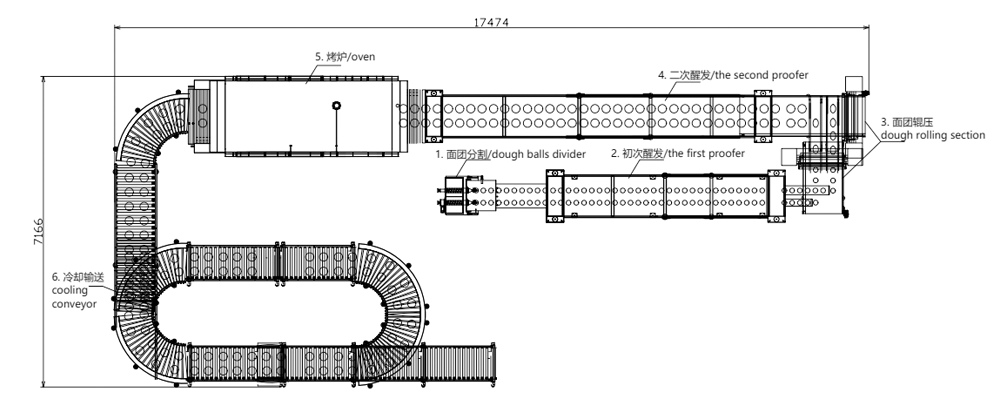
| Production line Dimension | 17474*7166*2430(mm) |
| Capacity | 2000-6000pcs/h |
| Electricity | 380V, 50Hz, 3Ph, 17.25kW |
The process of the Pita Bread Production Line begins with dough fed directly from the mixer into a nozzle extruder that portions and cuts the dough into precise, uniform pieces. These pieces then pass through a first-stage proofing period for gluten relaxation, followed by multi-directional rollers that round each piece — working both longitudinally and transversely — into an evenly shaped, uniformly thick disc. A second proofing stage provides a final rest before the formed discs enter the high-temperature tunnel oven, where intense heat triggers the rapid steam expansion that creates pita's signature interior pocket.
The dual-proofing, multi-directional rounding approach ensures consistent round shape, even thickness, and reliable pocket formation across every piece — the hallmarks of quality pita production at industrial scale.
Production Process – From Dough to Finished Pocket Pita
The line accepts pre-mixed dough prepared in a separate offline mixer.
Stage 1: Dough Extrusion
Dough is loaded into a receiving hopper fitted with extrusion nozzles The nozzles continuously extrude dough portions directly onto the conveyor belt. This extrusion method ensures uniform dough portioning without the need for cutting or sheeting. The number of nozzles determines the row configuration – 2 nozzles for 2 rows.
Stage 2: First Proofing
The extruded dough portions enter a temperature- and humidity-controlled proofing chamber. This initial fermentation allows yeast activity to begin, developing gas and relaxing the gluten structure.
Stage 3: Rolling Pin Forming
The proofed dough portions then pass through two sets of rolling pins:
- First, a roller flattens the dough portion into a rough disc, spreading it evenly across the width.
- Rolling pin: Immediately after, a roller further flattens and rounds the dough into its final circular pita shape.
This two-direction rolling method ensures uniform thickness and perfect roundness – essential for even pocket formation during baking.
Stage 4: Second Proofing
The formed pita discs undergo a second proofing stage. This final fermentation further develops gas within the dough, preparing it for the rapid expansion that creates the pocket. The two-proofing sequence is critical for achieving an evenly inflated pocket without blowouts.
Stage 5: High-Temperature Baking – The “Pocket” Formation
The proofed pitas travel into a tunnel oven operating at 500–600°C. The intense heat instantly vaporizes water inside the dough, and the rapidly expanding steam forces the top and bottom layers apart, creating the signature pocket.
Stage 6: Cooling
Baked pitas exit the oven at high temperature and pass through a multi-tier cooling conveyor. This gradually reduces product temperature, preventing condensation and maintaining a soft, flexible texture.
The line is configured to produce pita bread in a range of common diameters, and its molding station can be easily adjusted to achieve different product sizes. This flexibility allows businesses to meet standard market requirements (e.g., 6-inch or 8-inch pita) or cater to custom orders (e.g., larger pita for wraps). The adjustable product size feature eliminates the need for multiple specialized machines, saving both space and investment.
Operation is managed through a simple PLC (Programmable Logic Controller) touchscreen interface. This system allows for straightforward control of line speed and key parameters (e.g., baking temperature and fermentation time), significantly reducing the learning curve for staff. Even operators with limited experience can quickly master the system, minimizing training time and ensuring consistent operation across shifts.
Constructed with a solid frame and food-contact parts made from SUS304 stainless steel—a material known for its corrosion resistance and food safety compliance—the line is built for steady daily operation. The design prioritizes ease of access for routine cleaning and maintenance: removable components and smooth surfaces prevent dough buildup, reducing downtime and extending the equipment’s lifespan. Additionally, non-food-contact parts use durable materials like PE and aluminum alloy, ensuring long-term reliability.
The line follows a streamlined 6-step process to maximize efficiency: 1) dough balls divider (for uniform dough portions), 2) first proofer, to activate yeast, 3) dough rolling section (for consistent thickness), 4) second proofer, to enhance texture, 5) oven (for even baking), and 6) cooling conveyor (to preserve freshness). This sequential flow ensures each pita bread undergoes the same precise treatment, resulting in consistent quality batch after batch. It operates on 380V, 50HZ, 3PH, 17.25KW power specifications, balancing performance with energy efficiency.
Ideal for mass production of pita bread to meet large-market demands. The line’s high efficiency and adjustable capacity allow factories to scale output based on seasonal trends (e.g., increased demand during holidays) and maintain consistent quality for retailers and distributors.
Provides standardized and consistent pita bread for chain restaurants, fast-food outlets, and sandwich shops. Whether used for gyros, wraps, or standalone flatbreads, the line ensures every pita has the same texture and size across all locations, reinforcing brand identity and customer loyalty.
Offers an efficient and stable production line for food export enterprises. The line’s ability to adhere to international food safety standards (thanks to SUS304 stainless steel construction) and produce large volumes makes it suitable for meeting the strict requirements of global markets, supporting businesses in expanding their export reach.
The capacity is directly related to the size of your pita bread. Smaller pita (e.g., 6-inch) will yield a higher hourly output, while larger pita (e.g., 10-inch) may reduce output. Since the line’s capacity is adjustable, we recommend sharing your target product size to receive a customized capacity estimate tailored to your needs.
To customize the line for your operations, please provide three key details: your desired pita bread size (diameter and thickness), your target production capacity (e.g., number of pita per hour), and your factory layout (available space for installation). This helps us optimize the line’s configuration and ensure it integrates seamlessly with your existing processes.
The production cycle is approximately 3 months, though this may vary based on specific customizations (e.g., adjustments to the oven or cooling conveyor). We will provide a detailed timeline once your solution is finalized.


