

close
Choose Your Site
Global
Social Media
Views: 0 Author: Site Editor Publish Time: 2026-02-23 Origin: Site


Puff pastry production lines are essential for efficiently producing high-quality puff pastry products, such as croissants, danishes, and puff pastry sheets. These lines are designed to automate the process of mixing, rolling, laminating, and baking dough, ensuring consistency and high volume production. There are two main types of puff pastry production lines: semi-automatic and fully automatic. Semi-automatic systems require some manual intervention for tasks like dough feeding and product shaping, offering flexibility and a more affordable initial cost. On the other hand, fully automatic lines handle the entire production process with minimal human involvement, resulting in faster production, improved consistency, and reduced labor costs, but at a higher upfront investment. The choice between the two depends on production needs, business scale, and budget.
A semi-automatic puff pastry production line is a system that automates some stages of the production process while still requiring manual input for others. Typically, the system automates tasks like dough mixing, rolling, and lamination, but operators are needed for functions such as feeding dough into machines, cutting, and shaping products. These lines use mechanical devices, conveyors, and adjustable rollers to ensure uniform dough layers and smooth operation, but they still depend on human oversight for certain parts of the process.
Semi-automatic lines offer several advantages:
Cost-Effective: Compared to fully automatic systems, semi-automatic lines have a lower initial cost, making them a more affordable option for businesses with smaller budgets or those just starting out.
Flexible: These lines provide flexibility in terms of adjusting for different product types and sizes. Operators can easily switch between product variations without significant machine reconfiguration.
Ideal for Small to Medium-Scale Businesses: Semi-automatic systems are particularly well-suited for businesses with moderate production needs. They strike a balance between efficiency and flexibility, enabling companies to scale production as needed while maintaining control over the process.
While semi-automatic lines offer flexibility and cost savings, they also have some drawbacks:
Slower Production Speed: Compared to fully automated systems, semi-automatic lines operate at a slower pace because they require manual intervention at various stages. This can limit the output, especially for businesses with high-volume demands.
Higher Labor Costs: Since manual labor is still involved in feeding the dough, cutting, and shaping the products, labor costs can be higher compared to fully automated systems, which run with minimal human involvement. This might be a disadvantage for businesses looking to reduce labor costs and increase production efficiency.
A fully automatic puff pastry production line is a fully integrated system that automates every step of the puff pastry production process, from dough mixing and lamination to cutting, shaping, and even baking. The system is equipped with advanced machinery that handles the entire workflow with minimal human intervention. The dough is automatically fed into machines, and the layers are precisely created using automated rollers, sheeters, and folding machines. The products are then automatically shaped and cut, with little to no manual labor involved. These systems are highly efficient and capable of running continuously with minimal supervision.
Fully automatic production lines offer several significant benefits:
Faster Production: With minimal human intervention, fully automated systems can operate much faster than semi-automatic lines, allowing for higher production volumes and quicker turnaround times.
Less Labor: Since most processes are automated, these lines require fewer operators, reducing labor costs and the risk of human error. The reduction in labor needs can significantly lower overhead expenses.
High Consistency: Automation ensures that every pastry is produced with uniformity, delivering consistent product quality in terms of size, texture, and appearance. This consistency is essential for maintaining brand standards and meeting customer expectations.
While fully automatic lines provide significant advantages, they come with some limitations:
Higher Initial Cost: The initial investment for fully automated systems is much higher compared to semi-automatic lines due to the complexity of the machinery and the advanced technology involved.
Complexity: Fully automated systems can be more complex to set up and operate, requiring specialized training for staff. Maintenance and troubleshooting can also be more difficult and expensive, requiring expert support and a well-established maintenance plan. Additionally, upgrading or customizing these lines may be more challenging due to the complexity of the system.
Semi-Automatic Systems: Require more human intervention for tasks like feeding dough, shaping, and quality control, offering more control but less automation.
Fully Automatic Systems: Minimize human involvement, handling the entire production process from start to finish with high efficiency and consistency.
Semi-Automatic Systems: Slower production speed due to manual involvement, suitable for moderate demand.
Fully Automatic Systems: Faster production with continuous operation, ideal for high-volume businesses requiring quick turnaround.
Semi-Automatic Systems: Lower initial investment but higher labor costs and slower production speed.
Fully Automatic Systems: Higher initial cost but offer long-term savings by reducing labor and increasing production efficiency.
Semi-Automatic Systems: Offer greater flexibility for adjusting product size and shape, ideal for custom or seasonal products.
Fully Automatic Systems: Less flexible in customization, but high-end models can still accommodate variations with certain adjustments.
When selecting the right puff pastry production line, it’s essential to match the system to your production needs, budget, and plans for scalability.
Production Needs: Assess your current production volume and whether you expect this to grow in the near future. A small-scale business with low to moderate demand may find a semi-automatic line sufficient, while a high-capacity, fully automated system would be ideal for businesses with high-volume needs.
Budget: Consider your initial investment capacity. Semi-automatic systems are more affordable upfront, while fully automated lines carry a higher cost but can save on labor and operational costs over time. If your budget allows for a higher initial investment and your business demands consistent high-volume production, a fully automatic line could offer better long-term value.
Scalability: Think about your growth potential. A semi-automatic line may be suitable for your current operations, but as your business grows, you might need to upgrade to a more scalable, automated solution. Choosing a production line that allows for easy upgrades or expansions is vital for future-proofing your business.
Small-Scale Operations: For businesses with limited space and moderate production demand, a semi-automatic puff pastry production line is often the best choice. It offers a flexible and cost-effective solution, providing adequate output without the significant upfront investment required for fully automated systems. Small-scale businesses can also adapt more easily to seasonal changes or customized products.
Large-Scale Operations: For high-volume manufacturers, a fully automatic line is often the most suitable option. These systems handle large quantities of production with minimal human involvement, ensuring consistent quality and maximum efficiency. Large-scale operations benefit from the faster speed, reduced labor costs, and ability to run continuously, making them ideal for businesses aiming to meet large or growing market demands.
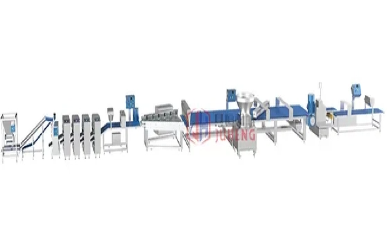
When selecting between semi-automatic and fully automatic puff pastry production lines, evaluate:
Production Needs: For high or growing demand, a fully automatic line ensures speed and consistency. For moderate demand, a semi-automatic line offers flexibility.
Budget: Semi-automatic systems are more affordable, while fully automatic systems have higher upfront costs but offer long-term savings through reduced labor.
Scalability: For growth, a fully automatic system provides better scalability, while semi-automatic systems are suited for businesses with steady, moderate growth.
Small-Scale Operations: Semi-automatic systems are ideal for businesses with moderate demand, offering cost-efficiency and flexibility for product variation.
Large-Scale Operations: Fully automatic systems are best for high-volume production, offering faster speeds, lower labor costs, and greater consistency.
Semi-automatic lines are more cost-effective initially, with lower upfront costs. However, fully automatic lines offer long-term savings by reducing labor costs and improving production efficiency, making them more cost-effective in the long run for high-volume operations.
Fully automatic systems operate much faster than semi-automatic lines because they require minimal human intervention. This leads to higher production speeds, making fully automated systems ideal for large-scale operations with high output demands.
Semi-automatic lines have limitations in handling high-volume production. They are best suited for smaller to medium-scale operations. For large-scale production, a fully automatic system offers higher efficiency, faster speeds, and less reliance on manual labor.
Yes, semi-automatic lines offer greater flexibility for switching between different product sizes and types. Operators can adjust settings manually, allowing for easy adaptation to varied product requirements. Fully automated systems, while faster, may require more technical adjustments for product changes.
Selecting the right puff pastry production line is crucial for aligning your equipment with your business needs and growth plans. For smaller operations with moderate demand, a semi-automatic system offers flexibility and cost efficiency. However, for larger-scale production, fully automatic systems provide the speed, consistency, and scalability necessary to meet high-volume requirements. It’s important to match the production line features—such as automation level, capacity, and cost—to your specific goals, whether it’s maximizing efficiency, reducing labor, or ensuring product consistency. By choosing a system that fits both your current and future business needs, you can ensure long-term success and optimal return on investment.


