

close
Choose Your Site
Global
Social Media
Views: 0 Author: Site Editor Publish Time: 2026-06-07 Origin: Site


Scaling the production of the traditional Chinese sandwich often forces food manufacturers into a compromise. You usually must choose between an authentic, chewy texture and high output volume. As demand for regional street foods globalizes rapidly, this operational dynamic shifts. Manual production creates unsustainable labor costs and serious quality bottlenecks. You simply cannot rely on hand-kneading to fill massive commercial orders daily. An automatic roujiamo line solves this problem entirely. It mechanizes dough lamination and forming processes without destroying the delicate gluten network. This guide breaks down the specific mechanical efficiencies you gain. We will explore essential procurement criteria and the implementation realities of upgrading to a fully automated system.
Volume vs. Consistency: Industrial lines stabilize output at 2,500–3,500 pieces per hour while maintaining uniform dough thickness and weight.
Process Integration: Consolidates mixing, pressing, fat-pumping, and rolling into a single, continuous workflow, eliminating intermediary handling.
Cost Control: Drastically reduces manual labor dependency while standardizing ingredient usage through precise PLC (Programmable Logic Controller) dosing.
Compliance: Systems utilizing SUS304 food-grade stainless steel ensure regulatory compliance and streamline end-of-shift sanitation.
Manual pastry making introduces massive operational variables into your facility. Bakers press dough differently depending on their fatigue levels. This human element leads directly to inconsistent product weight. You also suffer from poor lamination quality during late shifts. Furthermore, commercial bakeries face incredibly high labor turnover. Training new staff constantly slows down your daily output. Every new hire requires weeks of practice to perfect the rolling technique.
A dedicated roujiamo machine completely shifts your operational model. You move away from unpredictable, fluctuating labor costs. Instead, you secure predictable, fixed equipment overhead. This transition stabilizes your production schedule immediately. You know exactly how many units you will produce hourly. Factory managers no longer worry about shift absences halting the supply chain. You gain complete control over your daily output metrics.
Skeptics often worry about severe quality loss during mechanization. They assume automated systems create tough, overworked dough. This was true for older, cheap machinery. Modern systems, however, prevent this exact issue. Automated rolling devices use highly calibrated, gentle pressing mechanisms. They replicate the exact motion and pressure of hand-kneading. The dough retains its vital gluten structure perfectly. You achieve artisanal quality at an industrial scale. This critical balance ensures your customers stay loyal to your brand.
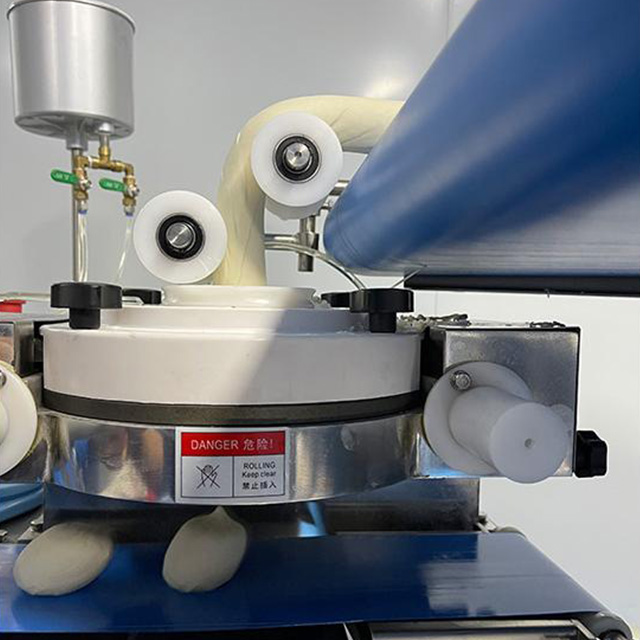
Let us look closely at the internal mechanical components. We need to understand where actual efficiency gains occur on the floor. Engineers design these parts specifically for delicate pastry work. They remove human error from the most challenging preparation steps.
These components gradually reduce dough band thickness. A typical robust setup uses three satellite heads. Three calibrating rollers follow these heads closely. This multi-roller approach prevents dough tearing completely. It ensures a smooth, flawless surface on every sheet. You maintain the signature "mo" texture at high operating speeds. The outside stays incredibly crispy. The inside remains soft and highly chewable. Hand-rolling simply cannot match this speed and consistency.
This critical unit injects shortening across the dough sheet. It spreads the oil evenly without manual intervention. It eliminates messy, manual brushing from your floor. The fat pump ensures exact fat-to-dough ratios every single time. You prevent expensive ingredient waste entirely. It also guarantees uniform flakiness in every baked piece. Precise fat distribution is the secret to a perfect crust.
This section cuts the dough into precise, measured widths. It then rolls them into consistent cylinders for final pressing. This action standardizes the diameter of every item. It also locks in the exact weight per piece. Consistent dimensions are crucial for downstream packaging lines. They make commercial sales highly predictable. Supermarkets require uniform product sizes for their freezer aisles.
Modern food manufacturing demands flawless, seamless integration. An integrated system proves its value as a turn-key solution. We will walk through the end-to-end production lifecycle. This complete 7-step cycle enables fast production without sacrificing quality. Factory owners rely on this workflow to hit major distribution targets.
Mixing & Resting: The process begins here. Automated proportioning combines flour and water perfectly. Integrated resting conveyors accommodate the crucial 30-minute resting phase. This step relaxes the gluten network for easier shaping.
Dough Pressing: The dough enters the main unit. High-precision rolling mechanisms create a uniform dough thickness. The rollers press the mass gently to avoid overheating the delicate yeast structures.
Fat Injection: The machine applies an automated layer of fat. It sprays a continuous, thin coating over the moving sheet. This creates the essential laminated layers required for flakiness.
Forming & Rolling: Precision components shape the dough. They cut the sheet and roll it into standard discs. The machine matches the exact diameter required by your packaging parameters.
Baking/Proofing: Products experience temperature-controlled transit. They move slowly through modular tunnel ovens. Careful baking achieves the characteristic golden exterior without burning the edges.
Filling (Optional/Hybrid setups): Some operations inject fillings automatically. Volumetric injectors add slow-braised meats accurately. This step creates a fully finished sandwich ready for immediate freezing.
Packaging: Cooling conveyors take over the final stage. They feed finished items directly into flow-wrapping machines. This prevents condensation inside the sealed plastic packaging.
Procurement requires careful, highly detailed technical evaluation. You must align equipment specs with facility realities. Buying a machine blindly leads to operational disaster. We outline the most important dimensions below.
Consider how to align machine throughput correctly. A standard industrial unit pushes out 3,500 pieces per hour. You must match this output with your current oven capacity. Also, rigorously check your blast freezer limits. Do not buy an automated line that outpaces your downstream bottlenecks. If your ovens only handle 2,000 pieces, the dough will over-proof while waiting.
Always verify equipment construction materials. Demand SUS304 stainless steel on all food-contact surfaces. Evaluate the washdown compatibility of the entire equipment line. Easy cleaning minimizes your daily sanitation downtime. Food safety inspectors look specifically for smooth, non-corrosive metals. Poor materials harbor dangerous bacteria and rust quickly.
Digital interfaces drive modern factory floor efficiency. Look for multi-language PLC touchscreens when browsing catalogs. English, Spanish, and Arabic interfaces help diverse workforces operate smoothly. Smart sensors allow quick, reliable recipe saving. This drastically reduces setup times during complex shift changes. Operators simply tap a button to load product parameters.
Assess your physical facility limits carefully. Review the 15kW power consumption needs for large setups. Confirm your 380V/3-phase electrical requirements before ordering. Check your pneumatic air limits. The equipment usually requires a steady 0.8-1.0 MPa air supply.
Evaluation Dimension | Ideal Machine Specification | Facility Preparation Requirement |
|---|---|---|
Production Capacity | 2,500 - 3,500 pcs/hour | Expand oven and blast freezer limits |
Material Hygiene | SUS304 Food-Grade Stainless Steel | Install washdown-compatible floor drainage |
Control Systems | Multi-language PLC touchscreen | Provide basic digital operator training |
Energy & Utilities | 15kW, 380V/3-phase power | Ensure 0.8-1.0 MPa pneumatic air supply |
Moving to automated baking introduces real physical challenges. You cannot plug in a complex machine and walk away. Careful planning ensures a smooth, highly profitable transition. Preparation protects your massive capital investment.
Installing a continuous line requires intense floor space planning. You might need to completely redesign your current factory workflow. Linear space is strictly non-negotiable for resting conveyors. They need long, uninterrupted stretches of floor. You cannot bend a resting conveyor around a tight corner easily. Measure your facility dimensions twice before placing any deposits.
PLCs reduce the need for skilled manual bakers. However, your maintenance staff requires brand new digital skills. They must learn sensor calibration thoroughly. They must master delicate pneumatic pressure adjustments. Troubleshooting digital PLC faults becomes a daily operational requirement. You must budget time for proper vendor training. Do not assume your mechanics can guess the correct settings.
Uptime depends entirely on your strict upkeep schedule. You must schedule regular, deep cleaning of the fat pump. This prevents severe mechanical clogging inside the narrow tubes. You also need scheduled lubrication of all rolling drive chains. Proper lubrication avoids catastrophic mid-shift breakdowns. A broken chain halts your entire 3,500-piece hourly output instantly. Keep detailed maintenance logs.
Transitioning to mechanical production achieves very specific business goals. It is not just about producing more units per day. It establishes verifiable, strict consistency across daily batches. You gain robust food safety controls for audits. You also secure predictable profit margins across quarters.
Consider the following next steps for your procurement journey:
Request comprehensive sample testing from manufacturers.
Run your specific dough recipes through the proposed equipment.
Demand transparent Service Level Agreement (SLA) terms.
Ensure fast global technical support is included.
Verify reliable spare parts availability for emergency repairs.
Encourage your procurement teams to run careful calculations. Map your current variable labor costs. Compare these directly against the technical specifications of top-tier units. Calculate a realistic ROI timeline based on these precise operational shifts. Automation protects your bakery from volatile labor markets forever. It secures your production capacity for the coming decades.
A: Space requirements vary by configuration. You need significant linear space for the dough bander, resting conveyors, and forming units. Buyers must request dimensional CAD drawings before finalizing any purchase to ensure exact facility fit. Proper spatial planning prevents costly workflow bottlenecks.
A: Yes. Most modern lines feature highly adjustable calibrating heads. They also include interchangeable cutting rollers. Operators can easily customize the exact diameter and thickness using simple PLC touchscreen settings. This flexibility allows you to target different market segments easily.
A: Daily upkeep primarily consists of cleaning the automated fat pump. Staff must wipe down all SUS304 stainless steel surfaces thoroughly. Operators should inspect the satellite rollers for sticky dough buildup. They must also clear the flour dusting mechanisms to maintain optimal food hygiene standards.


